

-
Top 10 Alternative Sights In Rome
Seen the Vatican? Done the Coliseum? Walked the . . . well you get it. From decorative crypts to Jetsons-like malls, here are the top 10 lesser known sights around Rome you’re unlikely to find in any travel guide.
By Sarah Parker
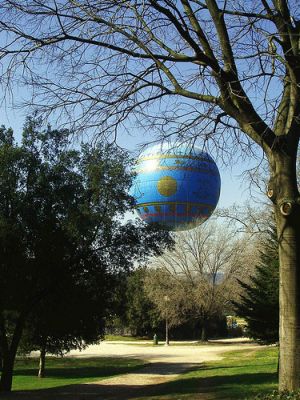
1. The Hot Air Balloon in Villa Borghese
Villa Borghese may be one of Rome’s most popular destinations during the warm summer months for locals, but not many visitors know about the giant hot air balloon located here. One of the largest in the world, this offbeat attraction allows you and 29 of your closest friends to rise 150 meters into the sky for some of the best views you can get of Rome, short of walking several thousand steps to the top of a cathedral.
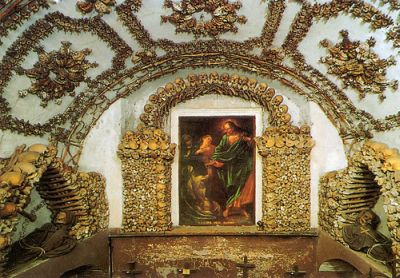 2. The Capuchin Crypt
Located beneath the church of Santa Maria della Concezione dei Cappuccini on the Via Veneto, this morbid attraction, perhaps best suited for Halloween time, consists of bones from over 4,000 French monks who are said to have fled their home country for the safety of Rome during the French Revolution and whose bones can now be found decorating the walls of the church’s many chapels in intricate patterns such as crosses, flowers, arches, and other happy shapes. Wondering what time it is? Check out the large clock on the wall composed of vertebrae, foot, and finger bones. (more…)
Monday, December 15, 2008 @ 12:01 am

Tags: Italy, off-the-beaten-path rome, Rome | Comments (0) Permalink
-
Why You Should Skip Thanksgiving And Live It Up In Greece This Year

Forget Thanksgiving and live it up in Greece for the holidays where you can enjoy uncrowded sights, great weather, and food that will blow away a turkey dinner any day.
By Laura Bridgestock
Want to take a Thanksgiving break that won’t break the budget? Head for Greece (just don’t order the fish…).
Greece’s thriving tourist trade is highly seasonal — three-quarters of visitors go between May and September — and there is a downside to visiting outside this period: you miss out on the main program of cultural events in the capital, plus the “party islands” virtually shut down. But there are compensations: accommodation and transportation can be dirt cheap, there’s an undeniable charm to exploring Athens’ atmospheric ancient sites without hoards of tourists to break the spell, and it’s not out of the question to find yourself turning a corner on an island coastal path and discovering a hidden beach that’s all your own.
Luckily, I’d saved enough days of holiday from work to be able to spend a whole week in the country, which I divided equally between Athens and the island of Tinos. But if you only have a long Thanksgiving weekend, the decision of whether to visit the famous city or the now equally renowned islands could be a tough one. Here’s how they compare . . . (more…)
Monday, November 17, 2008 @ 12:01 am
Tags: athens, Greece, tinos | Comments (1) Permalink
-
Exploring The Two Worlds Of Turkey

Understanding Turkey takes both time as well as effort, but what else do you expect from a country that spans two entire worlds?
By Ben Snook
Turkey is confused. It’s been confused for quite some time, in fact. Straddling the Bosporus, the country has its feet planted in both Europe and Asia (or Asia Minor, if you’re feeling classical). Politically, it has long been leaning towards Europe and is currently petitioning the European Union for admission; socially and religiously, though, Turkey is less certain about its future. Indeed, politics in Turkey is a sticky issue, best left well alone especially if you’re in the company of Turks. Despite holding regular elections and having a democratically chosen parliament, Turkey has clung firmly to laws that seem strangely out of place in the modern world. Criticizing the country publicly can lead to a prison sentence and exile; criticizing Atatürk — the modern nation’s founding father — attracts a similar penalty; mentioning the Armenian Holocaust, in which as many as 1.5 million Armenians were killed by the Ottoman regime between 1915 and 1917, is also strictly forbidden. The Turkish government, along with a majority of the Turks themselves still angrily deny that such an event ever took place and do not take kindly to being contradicted.
Despite Islam being the majority religion in the country, the divide between Mosque and State is sternly enforced: all state employees including teachers and civil servants are strictly forbidden from wearing religious symbols (most noticeably the headscarf); alcohol is not as freely available as it is elsewhere in Europe, but beer and raki (a popular anise-flavored apéritif in Turkey) are still served in many restaurants and cafés, especially in the western part of the country. Yet, this is a country of contradictions: despite the ostensible unimportance of Islam in Turkish society and its total exclusion from the business of government, every day at 5 p.m. the country reverberates to the haunting sound of the muezzin’s call as 40 million Turks make their way to prayers. (more…)
Monday, November 10, 2008 @ 12:00 am
Tags: turkey | Comments (0) Permalink
-
Falling In Love With Italy; It’s Easier Than You Think

A trip to Southern Italy is all it takes to show why it’s so hard not to love Italy, even when it’s not even trying that hard.
By Hillary Richard
I’m going to go out on a limb and say that it’s impossible not to love Italy, but that’s not due to a lack of trying on its part. Between the erratic driving, unhelpful local directions, and perpetually closed tourist offices, it’s the very definition of organized chaos, and the Campania region of Southern Italy is no exception. It’s very often confusing, at times frustrating, and never predictable, but always with an unparalleled, simple beauty that makes you forget everywhere else. With mild temperatures even at its coldest and a lack of tourists during the off-season, Campania is a great destination even during the fall and winter seasons.
Sorrento has become a popular tourist destination because of its vibrant, zesty feel and close proximity to other favorite spots in Southern Italy. Stereotypes abound in this ancient Roman town, glaring into the face of an increasingly fast-paced, global culture. People of all ages drive mopeds with reckless abandon; large Italian grandmothers hang their washing out in the middle of the city, beating the dust out of rugs from their balconies; and you can’t turn a corner without stumbling upon a lemon or orange tree sprouting from the ground. Flowers, wine, and food tempt you at all times of the day. (more…)
Monday, November 3, 2008 @ 12:01 am
Tags: amalfi, capri, Italy, sorrento | Comments (0) Permalink
-
Why Go Anywhere Else? Budapest In A Weekend

The key to a successful weekend vacation? Making the most of your time. So when I say Budapest is the “easy option” of eastern Europe, I mean it in a good way: you can dive right in and enjoy every second.
By Laura Bridgestock
Budapest has always been a step ahead of its neighbors in the Eastern Bloc — Budapest was, after all, the site of the first major uprising against the Soviets back in 1956. Whereas travelers visiting other cities around the region often end up scratching their heads trying to make their way about, Budapest is one of Central Europe’s (and the Continent’s) most visitor-friendly cities, which has both its upsides as well as its downsides. Most Budapesters speak some English and getting around the city is extremely easy to do. But being stopped every five minutes by someone offering you a guided tour can get annoying, and there’s only so many Subways that can spring up before it starts to detract from the city’s charm. But, at least for the time being, it’s still very possible to enjoy the best of both worlds, and to do so in just a few days. (more…)
Sunday, October 19, 2008 @ 6:27 pm
Tags: Budapest, Hungary | Comments (0) Permalink
-
SKOPELOS: READY FOR ITS CLOSEUP

Skopelos may be getting the Hollywood treatment, but this little Greek island isn’t letting it get to its head — with looks like this who needs Hollywood?
By Andy Boxall
As of the date of this publication, there are no official “Mamma Mia!” tours in Skopelos as there are “Sex in the City” tours in New York, but given Skopelos’ prominent role in the hugely successful film adaptation of the stage show, the idea doesn’t seem too far-fetched — in theory at least. In practical terms, it’s highly unlikely. This tiny island of 5,000, just to the east of Greece’s mainland, is about as eager to embrace its new-found famed as it is to embrace the modern world in general — which is to say: not at all. So you can breath a sigh of relief; you won’t find any ouzo Cosmopolitans here, but what you will find is a charming, beautiful Greek island with some of the best sights in the Aegean Sea, and with hardly a tourist in sight for most of the year. Or for that matter, a singing Pierce Brosnan, a godsend to all.
Just thirteen miles in length and five miles wide, Skopelos is perfect for anyone seeking seclusion. There’s no airport on the island, and the only way of getting there is via boat. If you’re combining your Greek visit with a few days in Athens — which is the recommended way of doing things — you can take a two-hour journey south to the port of Agios Konstantinos and board a catamaran that will take you to the inland in about two hours. (Or you can fly to nearby Skiathos and take an hour-long ferry from there instead, all depending on your tolerance for open-sea voyages.) (more…)
Monday, October 6, 2008 @ 6:00 am
Tags: Greece, Skopelos | Comments (0) Permalink
-
LIVIN’ THE HIGH LIFE IN GOTHENBURG BEFORE REALITY SETS IN
Enjoying the high life in Gothenburg, Sweden’s second largest city, without breaking the bank takes a little discipline and a lot of imagination.
By Matthew Stabile
There’s no doubt about it: I had traveled to Gothenburg in first class; once I got there it was back to reality. I’d just arrived from Stockholm on the X2000, Sweden’s high-speed train that reaches speeds of up to 125mph (200km/h) and ferries travelers between the two cities in a mere three hours. The downside is that the ticket costs about as much a discount airline ticket; the upside is that you’ll feel like you’re flying first-class. A few hours before, after helping myself to a glass of fresh juice and some fresh fruit from the á la carte kiosk, I settled into my plush, la-z-boy-sized chair, rolled it back to a comfy 45-degree angle, and watched out the window as the lush, green Swedish countryside quickly passed me by as I zoomed south to Gothenburg.
It’s these moments of travel that I look forward to the most: those rare moments during your trip, usually on your way from someplace to somewhere else, when you’ve got nothing better to do than to just sit back, relax, and replay the events of the last few days in you head. This usually happens after a hectic spurt of activity — in my case a couple of days running around Stockholm seeing the sights by day and heading out afterward to enjoy the nightlife, followed by an overnight ferry to Tallinn, Estonia, then back again. (more…)
Monday, September 22, 2008 @ 7:05 pm
Tags: Gothenburg, Sweden | Comments (0) Permalink
-
A WHITE NIGHT OUT IN STOCKHOLM
Sweden’s long summer days and cool nights out makes it one of the best places to visit in Europe come the longest day of the year.
By Matthew Stabile
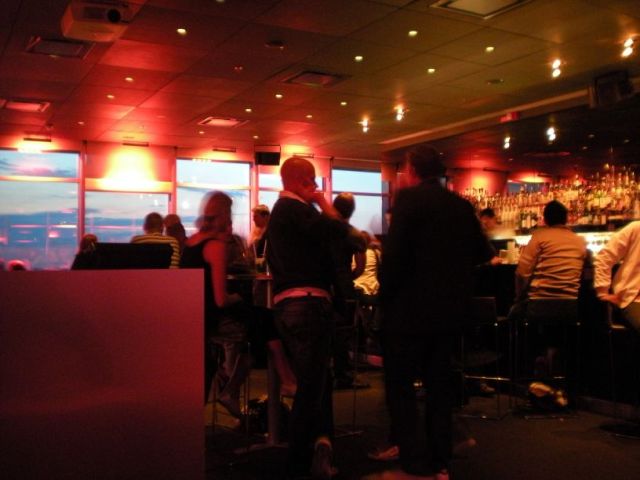
This was classic Stockholm. It was just past midnight and from our view in one of Stockholm’s highest rooftop bars we’d just watched the sun finally dip below the horizon, ending the luminescent sunset that had slowly been unfolding over the past hour or so. It was just a few days before the Midsummer holiday (or better known outside of the Scandinavian world as the longest day of the year) and though I had arrived just that morning, the extended daylight hours made it feel like I’d been there for days. “I can’t believe how many people are still out,” I said to my friend from Stockholm as I looked around the crowded bar. “It’s a Wednesday night.”
“Would you stay home on night like this?” she asked, gesturing to the floor-to-ceiling windows framing the sunset over the city skyline.
Point taken.
I had arrived in Stockholm with grand hopes for the Midsummer holiday. Back in the dark days of February when I booked my trip I was envisioning a Stockholm packed for the holiday, full of people out on the streets, partying under a warm, midnight sun — a sort-of Scandinavian Mardi Gras. I was nearly right about the midnight sun (it gets dark shortly before midnight and becomes light around 3:00 a.m. — an unwelcome sight for late-night revelers), but I was not so right about the warmth (June can still be quite chilly) nor was I right about the raucous street parties (the city actually empties out come Midsummer). But, as other expectations go, it was already clear to me that Stockholm was living up to the hype it’s been receiving as Scandinavia’s emerging capital of culture, with its thriving music and arts scene, a bustling nightlife, and a fondness for innovative design known the world over. (more…)
Monday, September 15, 2008 @ 6:55 pm
Tags: Stockholm, Sweden | Comments (0) Permalink
-
THE ENCHANTMENT OF A GREEN CITY IN GREEN SPAIN
Exploring the magical city of Oviedo, the jewel of northern Spain.
By Beebe Bahrami
Jetlagged but finally at our destination, Miles and I checked in at the Hotel Favila, dropped off our backpacks, splashed our groggy faces with cold water, and joined the swelling crowd for the evening stroll along Calle Uria. The critical mass carried us past the magical forest of Campo de San Francisco Park. Men and women were paseando through the park, dressed in the year’s colors of brown and violet, fuchsia and black, and wrapped in Kashmir shawls and suede jackets. We went on toward the medieval neighborhood with its towering Gothic cathedral and golden arched passageways.
We were in Oviedo, the capital of Spain’s northwestern province, Asturias. Oviedo has become something of an annual pilgrimage for us before we venture into the enchanting coastal wilds of the province. Oviedo is enchanting in its own right. This green city casts a spell through her intimate avenues of sandstone, marble and carved wood, her jovial residents who help the visitor without a moment’s hesitation, her golden cider bars, her Celtic and pre-Romanesque motifs, and her fresh, locally grown/caught/hunted food. A university town, Oviedo is surrounded by rolling green hills and mountains while the Atlantic Ocean is only a forty-minute drive away. (more…)
Monday, August 25, 2008 @ 6:45 pm
Tags: Oviedo, Spain | Comments (0) Permalink
-
LOSE YOURSELF IN THE LANGUEDOC
Tucked far away in the South of France, Languedoc is one of the country’s most unique and charming provinces; sometimes causing a visitor to forget that they’re in France at all.
By Ben Snook
To this day, the people of Languedoc are proud of their heritage and many still regard northerners with a certain amount of suspicion. Until the thirteenth century Languedoc, the southern province in France between the Atlantic and Mediterranean coasts, was fiercely independent from the king in Paris and as a result of its forceful incorporation into the French state, a stubborn streak of nationalism still remains. For example, having a Paris license plate this far south is guaranteed to get you cut off and shouted at on the road.
These days, Toulouse, the home of the European space program amongst other things, is still the industrial and financial center of the region, but the town of Carcassonne is the undoubted capital of tourism. An UNESCO world heritage site, this medieval town was saved from demolition and partially reconstructed, not altogether authentically, in the nineteenth century and much of the original medieval city remains. Surrounded by gently undulating olive groves and vineyards, the city is a magnificent sight to say the least: its soaring walls and formidable towers loom above the gentle landscape for miles around, creating one of southern Europe’s most spectacular landmarks.
For some, though, the city itself can be something of a let down. When I first visited in early summer the tourist season was just getting going and the crowds were starting to descend on the south of France in ever increasing numbers. As I walked through the magnificent, towering gatehouse to enter the old city I overheard an American boy shout to his mother, “Wow, it’s just like Disneyland!” Quietly horrified, I ignored him and pressed snobbishly on up the main street.
Twenty minutes later I could see his point. The narrow, cobbled alleys winding steeply up through the city towards the citadel very nearly felt like they had hardly changed since the thirteenth century. Hardly, that is, apart from the endless rows of medieval-themed gift shops, medieval-themed restaurants and medieval-themed bars which dominated their lower levels. Of course, there are parts around the walls — near the cathedral, in the citadel and in the main square — where you can still appreciate how the city might have felt some 800 years ago. It’s here where you’ll fine the charming, shady squares and beautiful, small bars built into the old walls which are quite unique (if you
can find them).The defining gastronomic experience of the Languedoc is Cassoulet. Much like the area’s leading tourist attractions, this can be somewhat hit and miss. On my first visit to Carcasonne, still dazzled by the astonishing surroundings, I simply wandered into the first restaurant I could find and ordered a steaming pot of it. Based around a duck confit, cassoulet is a fatty casserole with beans, pork, sausages, chicken and whatever else the chef has lying around the kitchen. This first experience of the dish was certainly memorable. From where I sat I could watch the sun as it sank behind the rapidly silhouetted city walls while sipping excellent local red wine and listening to distant accordion music; the place could barely have been any more perfect. Then the cassoulet arrived. A steaming pot of molten grease with unidentified chunks of meat floating amongst a scattering of browned butter beans, it reminded me immediately of a sewage outlet pipe. Nevertheless, I was hungry so I dug in. Immediately I regretted it and continued to do so for the next 24 hours. Having resolved never to try this abomination again, I was finally convinced by a French friend that it really wasn’t all like that. “Every one is different,” he told me. Taking his advice (and safe in the knowledge that my travel insurance was fully comprehensive), I tried again. In a different restaurant this time, I bravely ordered up the house speciality cassoulet and set about dulling my senses with as much vin de pays as I could get down my throat before the meal arrived. I needn’t have worried: far from the pock-marked oil slick I had eaten before, this second example was rich and tasty, the meat perfectly cooked and resting on a fragrant bed of herb-scented beans. It was absolutely delicious.
There is a lot more to the Languedoc than just Carcasonne and cassoulet, though. Driving out in almost any direction takes you through endless acres of gently rolling vineyards, most of them happy for you to taste their wine (of which they are fiercely proud) if you ask. To the north of Carcasonne, the black mountains loom out of the surrounding plains. A steep climb over them takes you through dramatically changing scenery: in no time, the sun-drenched vineyards have given way to cool but humid mountain tracks and densely forested peaks. The small town of Castres is a classical French provincial town: a magnificent waterside, an imposing Baroque cathedral and a myriad of pleasant, shady squares. Beyond Castres, to the north, is Albi which boasts one of the most spectacular cathedrals in all of southern Europe. Heavily fortified, this building is an uncompromisingly brutal statement of the orthodoxy imposed on the region in the aftermath of the crusades. Less spectacular than Carcasonne, Albi also feels less like a theme park and, for that alone, is well worth a visit.
In the opposite direction, southeast of Carcasonne, is a quite different side of the Languedoc. Narbonne, which is adjacent to a series of tidal lagoons stretching seven miles inland from the coast, has a completely different feel to the interior of the region. A provincial seaside town, it’s full of brightly colored buildings and boasts a stunning market. French markets are something to behold wherever you are in the country. Invariably, they’ll be full of local vegetables, meat and fruit. Buying something is an experience in itself: if you don’t barter, they look at you as though there’s something wrong with you; if you do dare to, they look so offended that you slink off with your tail between your legs embarrassed that you even asked in the first place.
In Narbonne, fish is the speciality. Countless stalls full of every kind of seafood offered up by the Mediterranean dominate the place. The produce is so fresh that all you can smell is the salt of the sea. The vendors will tell you at great length from behind a five-foot-high mountain of assorted shellfish how fishing is dying, how there’s not as much as there used to be, and how you’re lucky you came when you did, because if you’d come tomorrow, there might not be any fish left. Somehow, though, there always is.
The Languedoc is the kind of place you can very happily get lost in and not realize. It is one of the few places in Europe that has absolutely everything: the rich, tasty food; the delicious local wine; the unspoiled beaches; the medieval, hilltop citadels. Tourism has affected the place, certainly. The coast is not without its resorts and the interior certainly not without its gift shops. Nevertheless, the French are fiercely protective of their region. The Languedoc, unlike so much of many other parts of Europe, has a real sense that French people still live in it. The culture there is genuine, not put on for the benefit of affluent tourists. For all this, when you’ve been once, I guarantee you’ll go back. I did.
Monday, July 21, 2008 @ 4:57 pm
Tags: Carcasonne, France, Languedoc, Narbonne | Comments (0) Permalink
| Recent Articles |


